



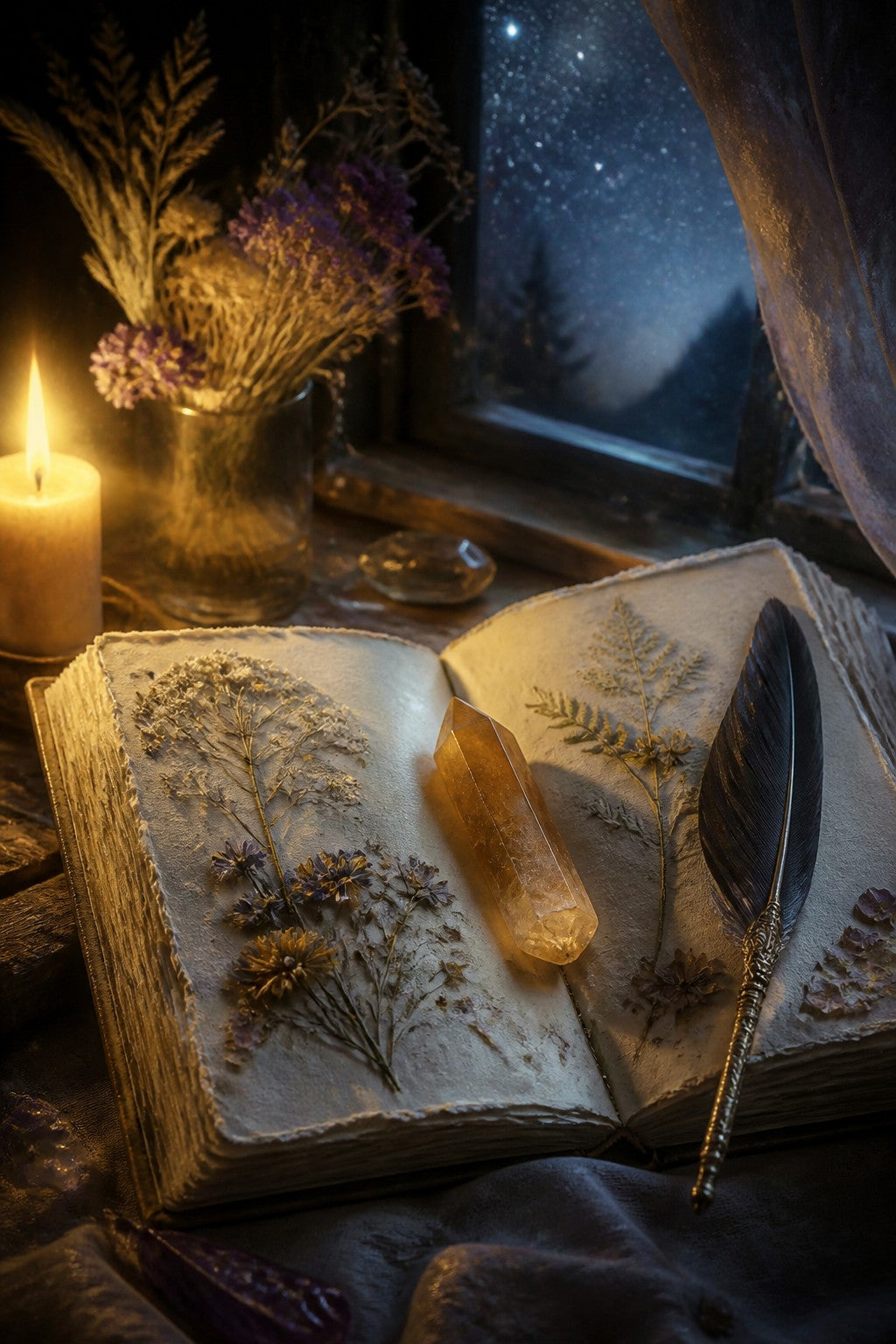
Many people collect crystals for years without writing a single word about them. That is perfectly fine. Yet there is something special that happens when you begin to keep a crystal journal. Stones stop being objects on a shelf and become part of a story you can read back.
A crystal journal is simply a notebook where you record your experiences with stones: which ones you reach for, when, why, and what you notice. Over time, it becomes a mirror of your own seasons and needs. This guide shows how to begin.

Why keep a crystal journal
It sharpens attention. Writing slows you down. When you write about a stone, you notice its color, weight and texture in more detail.
It reveals patterns. After a few months, you may notice that you always reach for a certain stone during busy weeks, or that a particular color shows up when you feel tender. Those patterns teach you about yourself.
It keeps your experiences honest. Memory is slippery. A journal holds what actually happened rather than what we later imagine happened.
It deepens the relationship. Writing turns a quick touch into a moment of reflection. Even two sentences a day can change how you relate to your collection.
What you need
Very little. A notebook you enjoy writing in, a pen, and a few minutes. Some people like a dedicated notebook only for crystals. Others keep a section in a larger spiritual journal. A digital note works too, though many people find handwriting slower and more reflective.
If you enjoy guided structure, a prompt journal can help you return to the page each day. The Be Present 100 Guided Prompt Journal pairs well with a crystal practice because its prompts center on noticing the present moment.
Start with a stone profile page
For each stone you own, create a simple profile page. Include:
- Name of the stone.
- Where and when it came to you. A shop, a gift, a trip.
- What drew you to it. Color, shape, a feeling, a word.
- Your first impressions. How it feels in your hand. Warm or cool, heavy or light, smooth or textured.
- Traditional associations. What crystal traditions say about it. You can find these in guides such as Rose Quartz: A Gentle Guide to the Heart Stone.
- Your own associations. What this stone means to you personally, which may be different.
These pages become a little encyclopedia of your collection, written in your own voice.
Daily or weekly entries
Beyond profile pages, the heart of a crystal journal is regular entries. You can keep them very short. Here is a simple format:
- Date.
- Stone I chose today.
- Why I chose it. One sentence.
- How I used it. Carried, held in meditation, placed on desk.
- What I noticed. One or two sentences about your day, mood or thoughts.
You do not need to claim that the stone caused anything. You are simply recording what you chose and what you noticed. Over time, the patterns will speak for themselves.
Prompts to deepen your writing
When you have a little more time, these prompts can open richer reflections.
- What quality am I hoping to grow right now, and which stone reminds me of it?
- Which stone have I not touched in months? Why might that be?
- If this stone could describe my week, what would it say?
- What color am I drawn to today, and what feeling does that color hold for me? The guide Color Energy: What Each Color Does for Your Mood and Aura can spark ideas.
- Which stone would I give to a friend who is struggling, and why?
- What is one intention I want to set with a stone this month?
Tracking moon cycles and seasons
Some people enjoy noting the moon phase or season in each entry. This can reveal interesting rhythms, such as reaching for softer stones in winter or brighter stones in spring. If moon tracking appeals to you, Moonlight Journal Without Pressure offers a gentle approach.
Sketching and color
You do not need to be an artist to sketch your stones. A quick outline and a few colored pencil strokes can capture something words miss. Many journals become more personal and joyful once small drawings appear. You might also tape in a photo of a new stone or press a flower from the day you brought it home.
Avoiding pressure
A crystal journal should feel like a friend, not a chore. If you miss a week, simply begin again. If you only write once a month, that is still a record. Some of the most meaningful journals are sparse, with long gaps and honest returns.
It also helps to avoid judging your entries. There is no right way to experience a stone. If one day a stone feels like nothing at all, write that down. Neutral days are part of the story.
Reading back
Every few months, set aside time to read your journal from the beginning. Look for:
- Stones you reach for most often.
- Stones that appeared during particular life events.
- Changes in what you hoped for or focused on.
- Small moments you had forgotten.
This review can be surprisingly moving. You may see how much you have grown, and how faithfully you showed up for yourself.
A five minute evening ritual
If you want a simple routine to begin, try this each evening:
- Hold the stone you used today.
- Take three slow breaths.
- Write the date, the stone and one sentence about what you noticed.
- Close the journal and place the stone in its resting spot.
That is all. Five minutes, one sentence, one stone. Small and repeatable is better than ambitious and abandoned.
Closing thought
A crystal journal is really a journal of attention. The stones are the doorway, but the real subject is you: your seasons, your hopes, your quiet daily courage. Begin with one page and one stone, and let the book grow alongside your collection.
For more reflective practices, visit Journaling for the Soul: Pages That Listen Back and explore the Free Light Library.
Can we pray for you?
Fill out a request here, and we will gently hold your prayer, intention, or gratitude in light.


